Offline Conversions
Part of Paid search reporting for sales teams
Reporting cost per closed customer from search
Calculate search cost per closed customer with a defined spend cohort, distinct-customer rule, date basis and visible open pipeline.
To report cost per closed customer from paid search, divide spend for a defined acquisition population by the distinct customers from that population who have closed. State the campaign set, customer rule, date basis, record coverage and still-open pipeline beside the result. Without those details, the ratio is easy to misread.
Define the customers and spend
Decide what “closed customer” means. A service business might use a won deal; a retailer might require a completed order. Set a rule for cancellations, repeat orders and several deals from one customer. If the label says “per customer”, count distinct customers rather than deals.
Choose the search activity in scope and use its spend consistently. Own-brand and non-brand campaigns may deserve separate views. Do not put every sale made during an advertising period into the denominator.
Include a customer in a search-linked view only when the business records support that classification. Attribution gives an interaction credit; it does not prove that advertising created the customer.
Choose the date basis
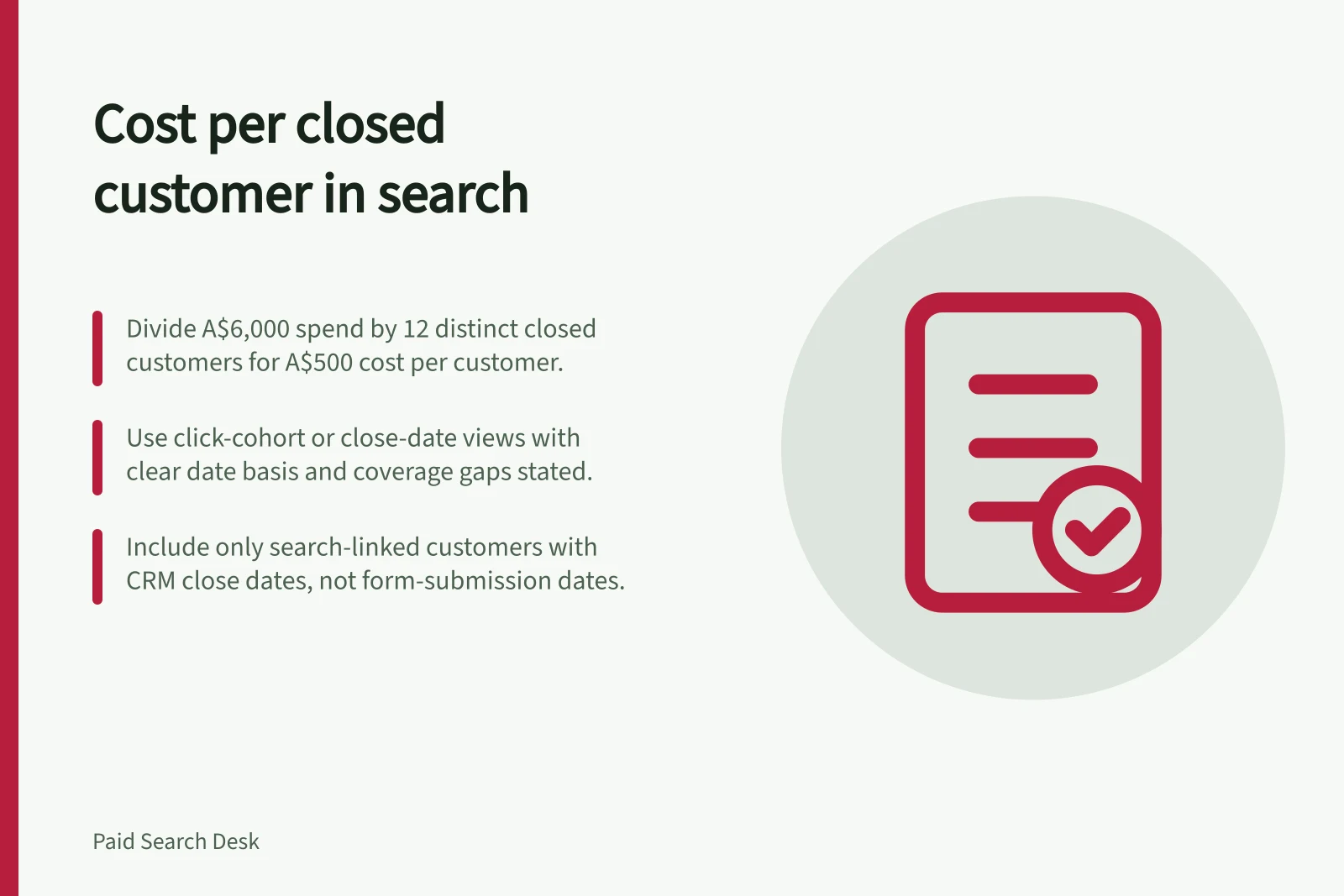
A click-cohort view takes a period of paid search spend and follows customers attributed to interactions in that period until they close. It helps assess that period’s acquisition spend, but it remains incomplete while relevant opportunities are open or outcomes have not been matched. State how much of the business outcome population has a usable source record.
A close-date view counts customers who closed in a calendar period. Their earlier search interactions and spend may belong to prior periods. Dividing this month’s spend by this month’s closes can be a useful period summary, but it is not necessarily the acquisition cost of those customers.
Keep the business close date in the sales record. A form-submission date is not the later CRM close date; state which event date each report uses.
Report field / Definition to include
- Spend
- Campaigns, period, A$ amount and excluded acquisition costs
- Closed customers
- Distinct-customer rule and evidence of a search link
- Open pipeline
- Relevant opportunities still awaiting a decision
- Date basis
- Click cohort or close date
- Coverage gap
- Missing source records, unmatched outcomes and unassessed leads
Calculate and qualify the result
Suppose a hypothetical click cohort cost A$6,000 and 12 distinct customers linked to it are confirmed closed. The measured ratio is A$500 per closed customer.
If five relevant opportunities remain open, label the cohort result provisional. If source links are missing for other customers, state that coverage gap too. These figures illustrate arithmetic, not a performance standard.
When the denominator is zero, show “no closed customers yet” rather than a numeric cost. Do not assign an unmatched sale to search by guesswork. Use the business count of distinct customers for the denominator; a conversion total is not necessarily a count of distinct customers.
Compare the ratio with the business’s own allowable acquisition spend and customer contribution on a consistent cost basis. State whether agency fees and other acquisition costs are included. Review the cohort again after its sales cycle has had time to mature, and date changes to the campaign mix, attribution method or close rule before comparing results.