Keyword Research
Part of Paid search strategy for Australian businesses
Brand search versus non-brand acquisition
Separate own-brand search from non-brand acquisition and assess each budget against its purpose and measurement limits.
Brand and non-brand Search answer different budget questions. A search for your business by name may help someone find the right page or current offer.
A search for a product or service without your name may reach someone still choosing a supplier. Keep the costs and outcomes separate before deciding what each budget deserves.
Classify the query and its purpose
Build an own-brand term list from your business name, relevant product names and distinctive variants. Include name-plus-service combinations for review, and flag names that could be ambiguous.
Read the whole query before classifying it. A clear business or product name makes it own-brand, including when paired with a service; a query without one is non-brand, while an unclear name stays mixed or ambiguous until the surrounding words clarify it.
A competitor's name is not your own-brand demand. Classification describes the query; it does not show whether an ad gained a customer who would otherwise have gone elsewhere.
Google Ads has brand settings for Search and Performance Max. Check resulting searches where report data is available rather than assuming a brand setting has measured new demand.
| Demand | Budget question | Reporting caution |
|---|---|---|
| Own brand | Does the ad provide a useful route or message for someone seeking us? | An ad-attributed conversion might have happened through another route. |
| Non-brand | Can we serve people comparing solutions? | Clicks can include unsuitable requests. |
| Mixed or ambiguous | What does the whole query suggest? | A name alone may classify intent poorly. |
Use the search terms report to review reported queries where data is available. Google Ads match types can reach related queries, so a keyword labelled 'brand' does not prove every resulting search contains your brand.
Give each budget a reason
Brand spend may be useful when an ad can present a current offer, booking route or message clearly. Judge that purpose against its cost rather than treating brand conversions alone as proof of new demand.
If brand activity dominates a limited budget, examine non-brand results separately so existing demand does not obscure acquisition performance. Do not let a strong brand result stand in for evidence that non-brand acquisition is working.
For non-brand acquisition, start with needs the business can fulfil. Send those searches to a page that answers the buying question, and compare spend with accepted enquiries or sales; click volume alone does not justify expansion.
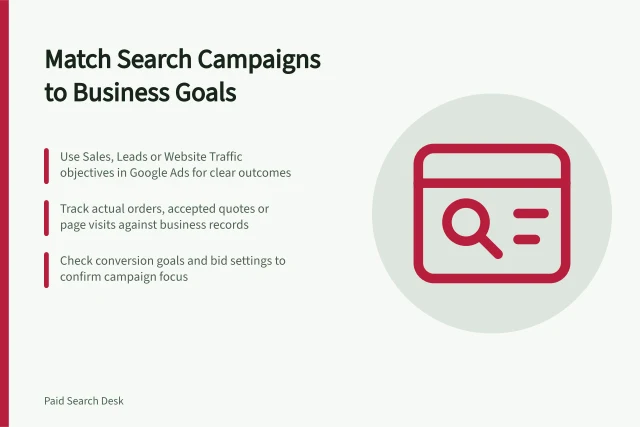
Keep campaign names, budgets and reporting clear enough to show which traffic each budget is intended to serve. Compare brand and non-brand on the same conversion definition, using measures such as cost per acquisition (CPA) or return on ad spend (ROAS) where appropriate.
Google Ads match types can reach related queries, so a keyword labelled 'brand' does not prove every resulting search contains your brand. The search terms report can help you inspect reported queries.
Interpret brand results cautiously
Read brand and non-brand results side by side using spend, reported conversions and CPA; where revenue is tracked, include ROAS. CPA is ad spend divided by acquisitions or conversion events, while ROAS is revenue attributed to ads divided by ad spend.
Use the same conversion definition and measurement window for both groups. Compare reported conversions with confirmed business outcomes, such as accepted enquiries or sales, rather than assuming every ad-attributed brand conversion was created by the ad.
A brand conversion may have happened through another route, so treat the reported result as observed attribution, not proof that the ad gained a customer who would otherwise have gone elsewhere. ROAS measures attributed revenue per advertising dollar; ROI includes profit and costs beyond ad spend.
Note other changes in demand or on the website when reading results. Compare like with like, then decide whether the brand route is worth its cost and whether non-brand is delivering the acquisition outcomes it is meant to serve.
Key Metrics for Evaluating Search Campaigns
- CPA (Cost Per Acquisition)Ad spend ÷ number of conversions
- ROAS (Return on Ad Spend)Revenue attributed to ads ÷ ad spend
- Attribution RiskNot all conversions are caused by the ad; some occur via other routes
- Measurement WindowUse consistent time frames for both brand and non-brand comparisons