Match Types
Part of Paid search strategy for Australian businesses
Choosing search campaigns by commercial objective
Match Search campaign goals, bidding focus and reporting to orders, qualified enquiries, traffic or visibility.
Pick a Search campaign structure from the business outcome you want. Then confirm its conversion goals, bidding focus and reports support that outcome. A click-focused bid strategy may help while learning, but extra visits alone do not prove progress towards sales.
State an outcome someone can verify
State the objective plainly: receive an order, accept an eligible quote request or send people to a specific information page. A separate campaign can make sense when an offer needs its own budget, location boundary or success measure. Wording variations of the same need usually do not require separate campaigns.
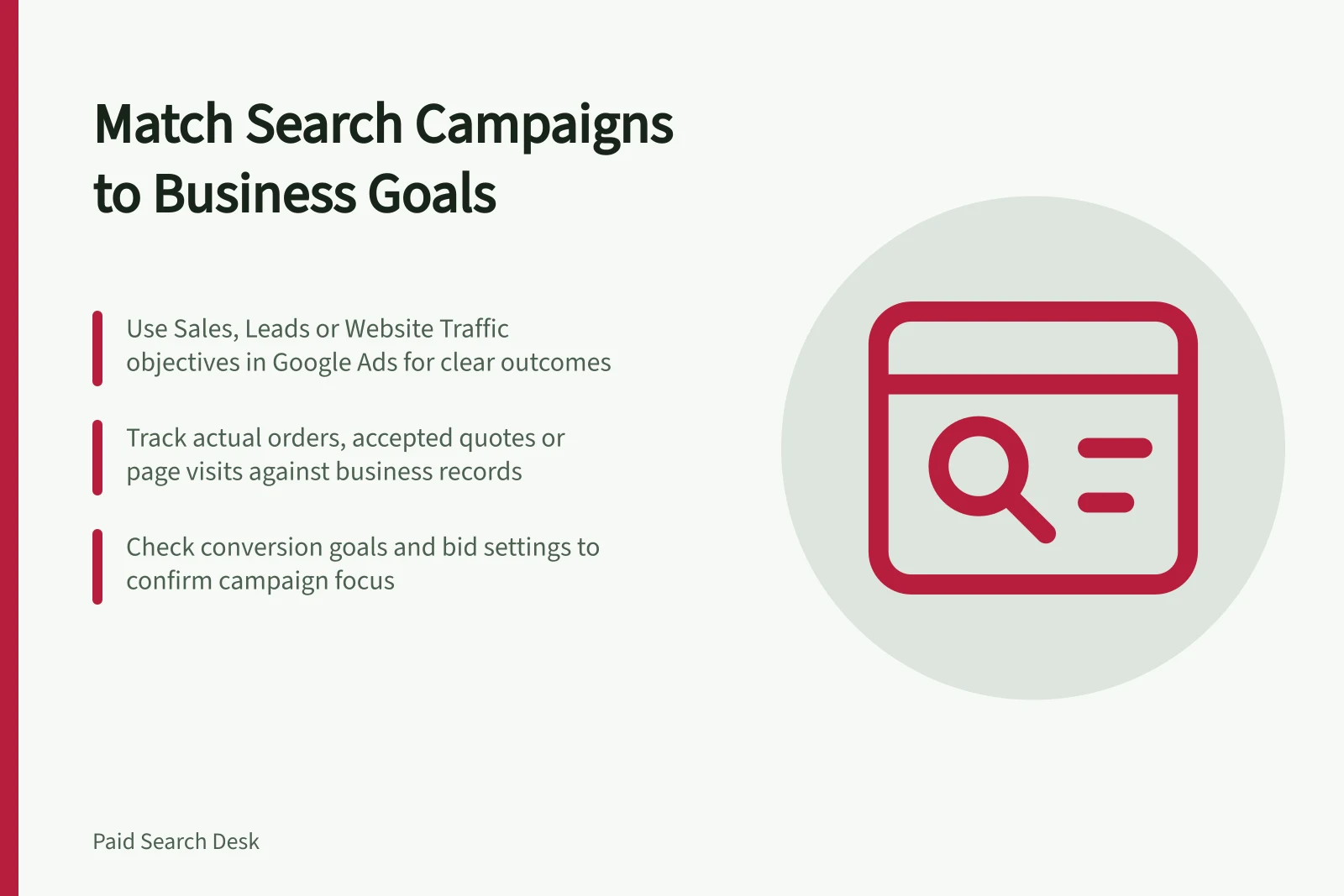
Google Ads' documented Search setup offers Sales, Leads and Website traffic objectives, plus an option to proceed without goal guidance. The label is a starting point; check the selected conversion goals and bid settings to see what the campaign optimises towards.
The documented setup requires at least one conversion goal even without goal guidance. New accounts may see a different setup workflow.
| Business objective | Campaign focus to consider | Check in business records |
|---|---|---|
| Online orders | Purchases and reliable order value | Missing orders, returns and the value that matters to the business |
| Sales enquiries | Recorded enquiries, followed by acceptance | Duplicates and requests the team cannot serve |
| Visits to a useful page | Clicks, with page visits checked separately | Whether visitors reached the intended information |
| Visibility for a defined need | Relevant impressions and Search impression share | Whether visibility is an intentional goal worth its cost |
These are planning choices, not promised results. Google Ads offers bidding approaches focused on conversions, conversion value, clicks and visibility. Search impression share is the share of estimated impressions the ad was eligible to receive, not a share of every search in the market.
Match the structure to the offer
A service business may need separate campaigns for services with different budgets or service areas. Where the outcome and operating settings are shared, ad groups may provide enough separation. Each ad and destination page should answer the need behind its searches.
Review network and budget settings before launch. Search partners and the Display Network can extend reach beyond Google Search pages. An average daily budget can be exceeded on individual days, subject to Google's applicable spending limits. Record these choices to interpret performance in context.
Judge the commercial outcome
Compare reported purchases with commerce records, and recorded enquiries with accepted opportunities. For a traffic objective, check whether people reached the intended page. For a visibility objective, review eligible coverage and its cost.
Google Ads generally uses primary conversion actions for bidding when the campaign selects their goal. Secondary actions are normally observed in 'All conversions'; a secondary action in a selected custom goal is an exception and can be used for bidding.
Check the actual goal configuration before interpreting the 'Conversions' column. Record the date of any measurement or objective change before comparing periods.
Key Performance Indicators by Objective
- Conversion type used for bidding
- Primary conversion actions
- Secondary actions tracking
- Observed in 'All conversions'
- Bidding focus options
- Conversions, conversion value, clicks, visibility
- Search impression share definition
- Share of estimated impressions the ad was eligible to receive