Negative Keywords
Part of Paid search strategy for Australian businesses
Deciding whether a keyword represents a viable customer
Judge a paid search keyword by customer fit, serviceability, page relevance and business economics before relying on volume.
Test a keyword when its likely searches could lead to people who want your offer, can be served by the business and might justify the cost of reaching them. Search volume cannot answer those questions on its own. Judge the candidate before launch, then revise your view using the searches and business outcomes it produces.
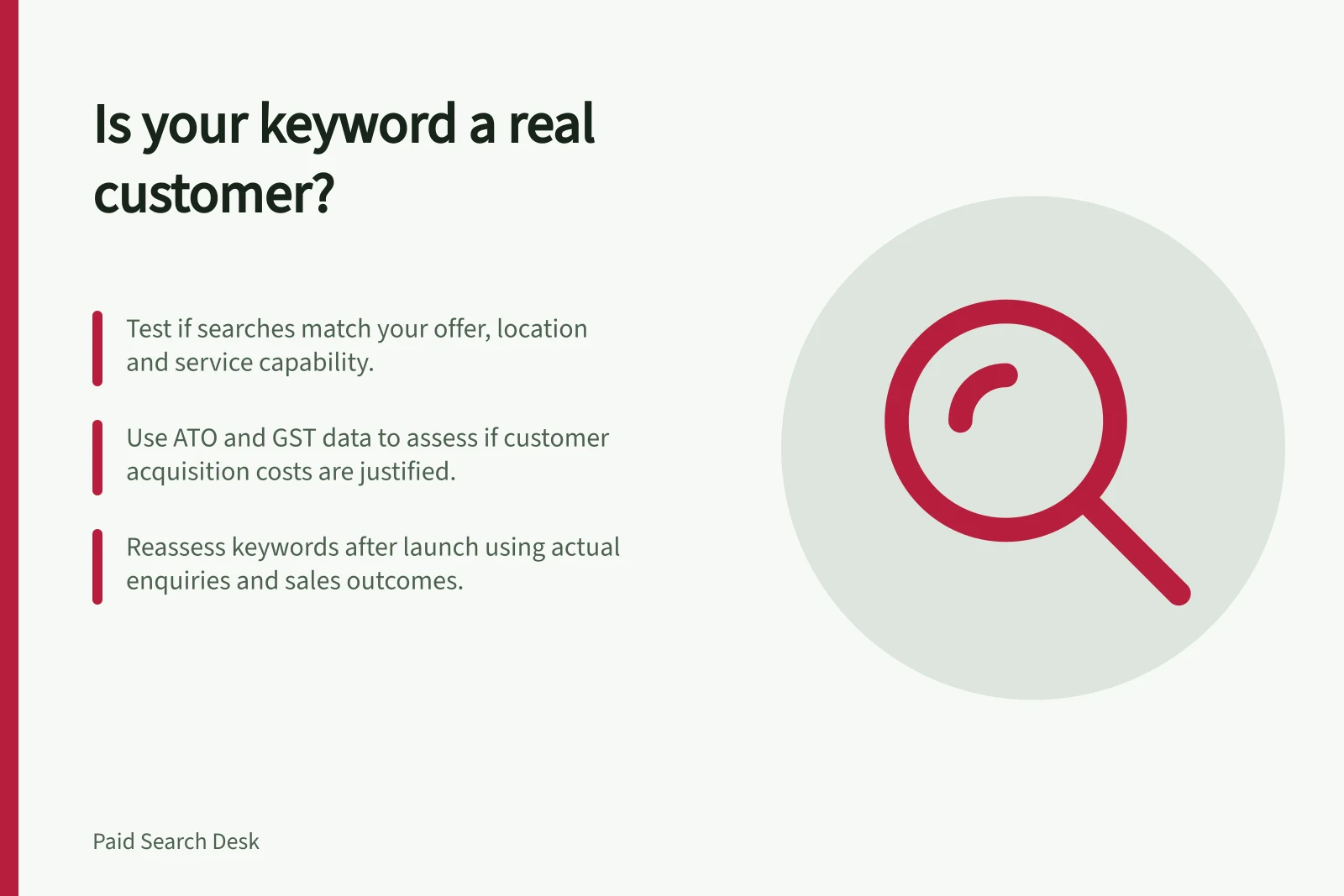
Test the customer behind the phrase
Write down the offer: product or service, eligible location, buyer type, important conditions and next step. For each candidate keyword, ask:
- Is the person likely trying to learn, compare, get support or buy?
- Does the business offer what they appear to want?
- Can the destination page answer that need?
- Could the team accept and fulfil the request?
- Could a resulting customer justify the cost of acquiring them?
For a business that repairs commercial refrigeration equipment, 'Commercial freezer repair' could describe a suitable request, depending on the equipment and service area. 'Freezer repair manual' more likely seeks instructions. 'Freezer' leaves the need unclear.
Keyword intent analysis: suitable vs. unsuitable phrases
- Commercial freezer repair
- Likely seeking service — fits offer and location (e.g., Sydney commercial premises)
- Freezer repair manual
- Seeking instructions — not a service request; unlikely to convert
- Freezer
- Too broad — need unclear; may lead to irrelevant traffic
Use planning data for what it can tell you
Google Ads Keyword Planner can suggest and refine keyword ideas. Its historical figures and forecasts help estimate possible search and ad activity.
Match type affects which searches may trigger an ad. The available options differ in how closely a search must resemble your keyword. No option guarantees that only the words in your list will trigger ads. Record any likely unsuitable interpretations before treating a forecast as addressable demand.
| Decision | Reason | What to record |
|---|---|---|
| Test | The likely need fits the offer and there is a suitable page | The expected customer and outcome to check |
| Hold | The phrase has promising and unsuitable meanings | What evidence would resolve the ambiguity |
| Reject for this offer | The likely need cannot be served | Why it does not fit this offer |
Use the business's own contribution per acquired customer and its observed path from enquiry to sale to set a provisional spending boundary. If the proportion of enquiries that become customers is unknown, do not invent an allowable cost per enquiry or bid from a Planner forecast.
Using Google Ads Keyword Planner: benefits and limitations
- ProsProvides historical search volume, forecasts, and related keyword suggestions; helps estimate ad performance
- ConsNo match type guarantees exact keyword matches; may trigger irrelevant searches; does not confirm serviceability or conversion potential
Reassess after launch
Review reported search terms alongside the matched keyword, spend and available outcomes.
Ask which enquiries were in scope, accepted and eventually sold. Many form submissions with few serviceable requests may call for a narrower offer or different search coverage; a low-volume phrase that creates useful work may deserve more attention.
Reassess when the offer changes. A new service, coverage area or page can make a previously unsuitable search worth testing, or make an old one unviable.
Key metrics to assess after launch
- Enquiries in scope
- Percentage of form submissions matching serviceable needs
- Accepted requests
- Number of leads your team can action
- Conversion rate
- Proportion of enquiries that become paying customers