Keyword Research
Part of Paid search keyword research
Grouping keywords by the problem a buyer wants solved
Group paid search keywords by the buyer's problem, the answer your offer provides and the next step. Keep ambiguous phrases visible for review.
Group paid search keywords when the same offer, answer and next step would serve the searches. Split them when a shared product word hides different buyer problems.
Describe the need first
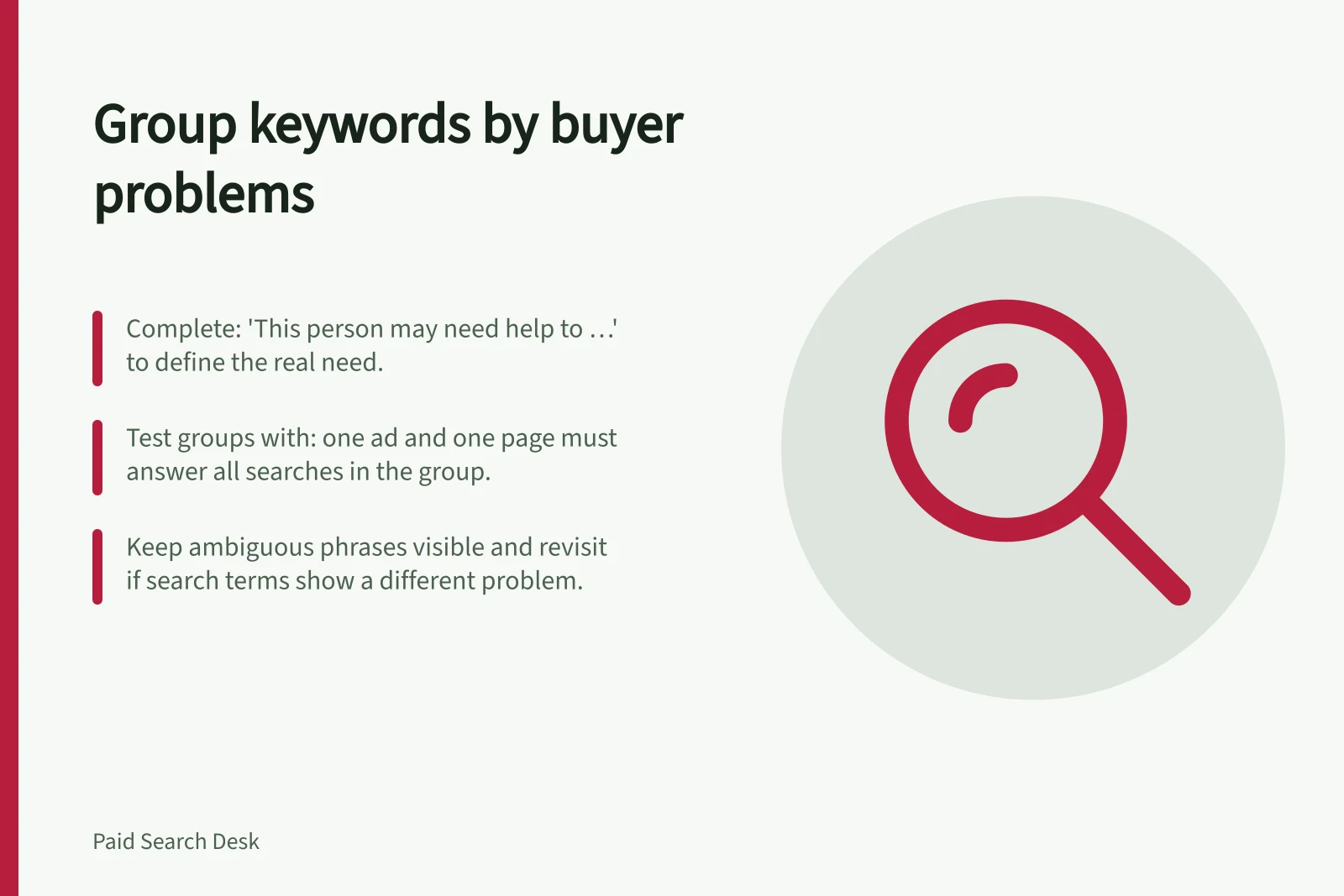
For each candidate phrase, complete: “This person may need help to …”. Add the likely task, product or service, and any condition that changes the answer.
If completing the sentence takes too much guesswork, or if a later distinction changes the offer or page, hold the phrase for more research until there is a defensible way to handle the likely searches.
Consider a hypothetical business that sells, repairs and maintains commercial coffee machines. “Commercial coffee machine repair” and “espresso machine technician” could both indicate a fault. “Coffee machine service contract” suggests planned maintenance. “Commercial coffee machine rental” asks for equipment without a purchase.
A repair message would not answer all three needs. These are possible interpretations, not measured search behaviour.
| Possible need | Question to answer | Possible next step |
|---|---|---|
| Fix a fault | What can be repaired, and where? | Request a repair assessment. |
| Arrange maintenance | What does the service include? | Discuss a maintenance plan. |
| Obtain a machine without buying | What equipment and terms are available? | Enquire about rental. |
The table does not imply that the business offers every service or needs three campaigns.
Test each proposed group
Ask whether one truthful ad could address the searches and one page could answer their main question. That test, not shared wording, decides which buyer needs belong together for a particular business.
Do not split phrases solely because one says “repair” and another says “fix”. Do split a parts purchase from a technician booking if they require different offers and next steps; record that reason.
If a distinct need has no suitable page, keep it in the research backlog rather than sending it to an unrelated page.
If you use a keyword research tool to discover further phrases, review any suggestions against the actual offer. No tool can establish which requests the business can fulfil.
Keep ambiguous phrases visible
“Coffee machine service” could refer to repair, planned maintenance or support. Write the possible meanings beside it and look for fuller wording such as “contract”, “fault” or “manual”. If the distinction changes the offer or page, the phrase remains unresolved.
After launch, compare reported search terms with the matched keyword and intended need. If visible terms point to a different problem, revisit the group definition and its offer.
Keyword Research Best Practices: Key Actions
- Ambiguous Phrase Example
- Coffee machine service
- Possible Meanings
- Repair, planned maintenance, or technical support
- Recommended Action
- Keep visible for review; seek clearer phrasing like 'service contract' or 'fault'
- Post-Launch Review
- Compare reported search terms with matched keywords