Keyword Research
Part of Search ad experiments
Testing a landing-page offer with a stable keyword set
Compare landing-page offers while keeping keyword coverage and measurement steady. Judge accepted outcomes, not form volume alone.
Keep search coverage and measurement stable while changing the landing-page offer visitors see. Define success first: more orders, more accepted enquiries or another business outcome. More form submissions help only if the requests still meet the business’s needs.
Define the offer change
Write both propositions plainly. For a hypothetical service business, the original page might invite a general quote request while the trial offers an assessment before quoting. Check that the business can deliver either promise and that the ad accurately describes the destination.
List what changes between the pages. A new offer may require a different heading, explanation and call to action; together these form an offer package. If the form, layout, pricing and follow-up process also change, the result cannot identify which component mattered.
If the ad must change to describe the trial truthfully, record the comparison as an ad-to-page offer test.
Hold search conditions steady
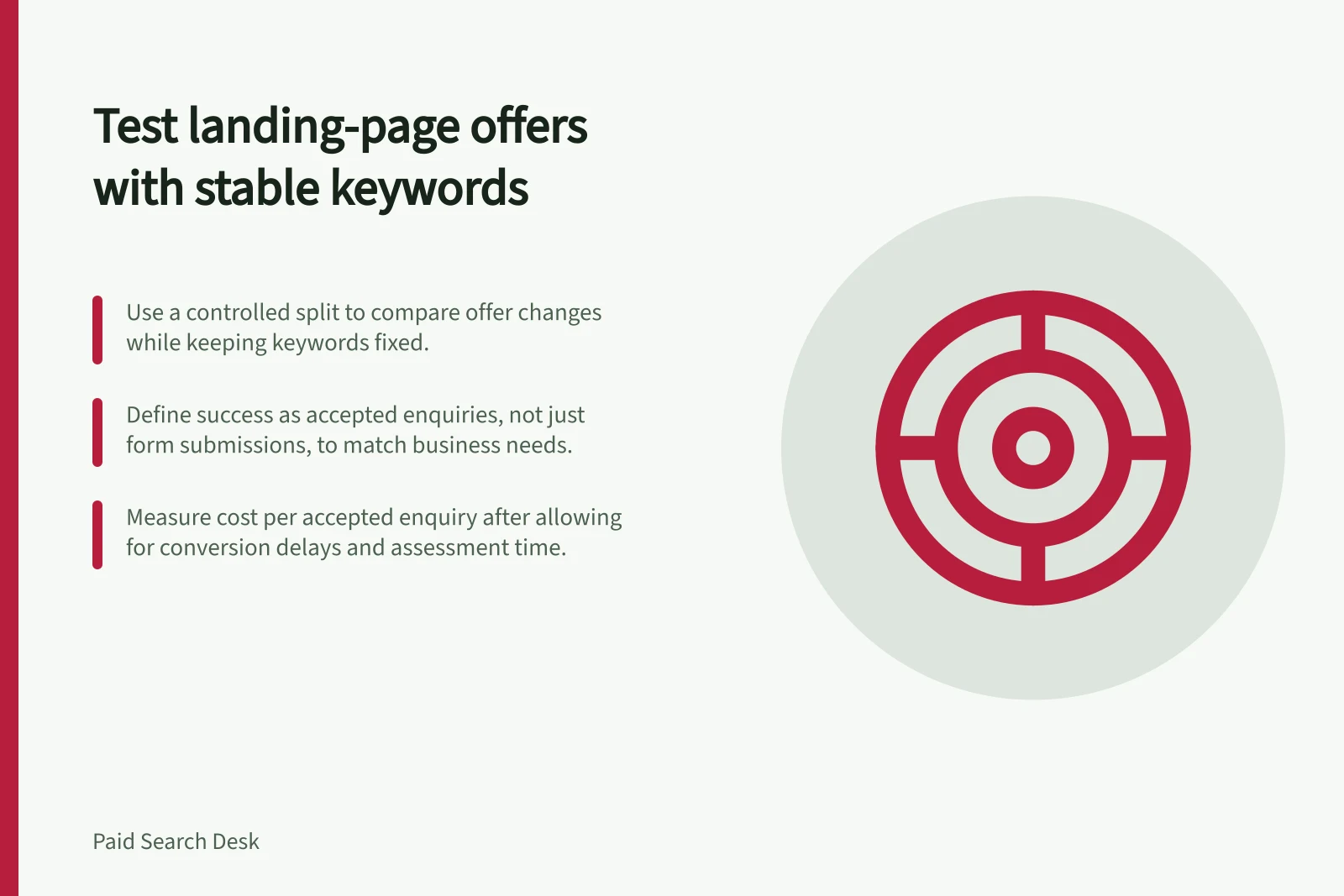
Use a controlled split to compare landing-page offers. Before launch, compare the intended keywords and match types, locations, schedule, negative keywords, conversion actions and other campaign settings in both arms. Record any necessary differences beyond the offer.
Choose a split that fits the visitor journey. The available Google Ads Help pages cover the Experiments page and custom experiments. Keep the comparison focused on the landing-page offer.
A stable keyword list does not guarantee the same individual searches or auction outcomes in each arm. Do not promise an arm-by-arm query-mix comparison. Treat any available search or audience diagnostics as incomplete context, not proof of identical traffic.
Measure the offer people accepted
Use the same conversion definition and counting rule for both arms. For enquiries, keep an internal submission ID and have the receiving team apply one acceptance rule. Compare accepted enquiries and cost per accepted enquiry once assessment and conversion delay have been allowed for. Keep raw submissions as a diagnostic measure rather than substituting them for the chosen outcome.
Before launch / At review
- Confirm both offers can be delivered and both pages work.
- Check serving, page failures and form failures.
- Record the offer and campaign differences.
- Note unintended setting or offer changes.
- Define the accepted outcome and review period.
- Compare mature outcomes under the same rule.
If the trial brings more submissions but fewer accepted requests, investigate whether the offer set the wrong expectation. If the difference remains uncertain or delivery was uneven, record that limit instead of declaring a winner from a higher estimate.