Keyword Research
Part of Paid search reporting for sales teams
Showing which queries may create useful sales conversations
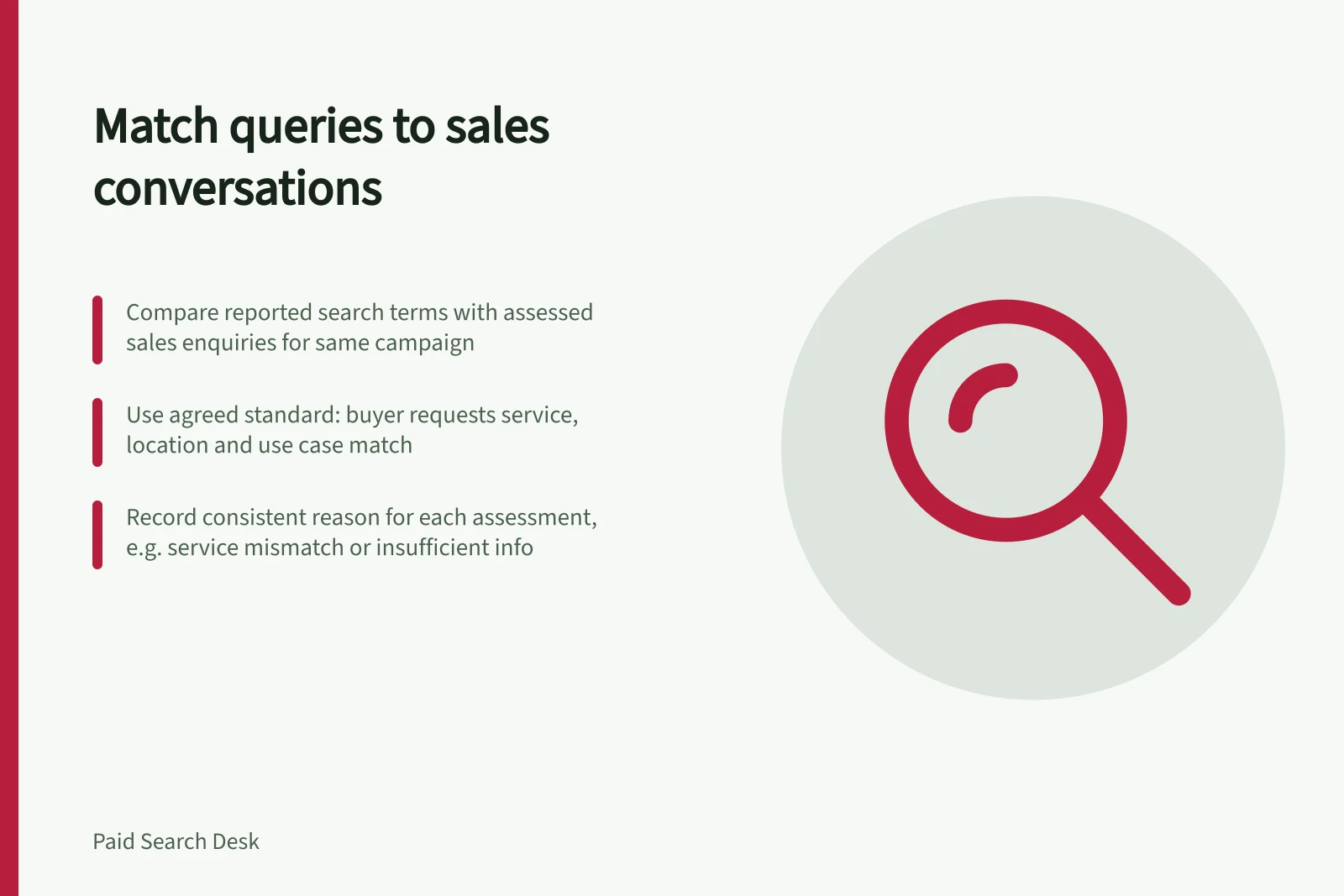
Compare visible paid search terms with assessed sales conversations while keeping aggregate reporting and missing queries clear.
Visible paid search terms can show customer language. Compare reported terms and available Ads measures with assessed enquiries from the same campaign or ad group. Call a term aligned with a useful conversation only when sales feedback supports the same need.
The named boiler-installation phrases below are possible searches, not observed terms from an Ads report. No report measures or sales assessments are stated for them. None can be identified here as a query aligned with a useful conversation.
Where records do not expose a term and an assessed conversation together, report that no query-level match is established. Do not name one.
Define a useful conversation
Agree an observable standard with sales. A conversation may be useful when the buyer requests something the business sells, has a location or use case it can serve, and gives enough information for a meaningful next step.
Keep “useful conversation”, “accepted enquiry” and “closed customer” separate if the team uses all three. Record a short, consistent reason when a conversation does or does not meet the standard. Agree any reason categories with sales before comparing records.
“Requested residential repair; commercial service only” is more actionable than “bad lead”. Use de-identified notes in the reporting pack. Respect the business’s access rules for customer records.
Read the visible query report correctly
Review the Google Ads search terms report for a period old enough for sales to assess the resulting enquiries. Record the report fields your view provides. Check their definitions against the Google Ads help page titled “About the search terms report”.
At a minimum, retain the reported term, campaign or ad group, and the total spend and measured action totals shown for that view.
Label the view “reported search terms”, not “all searches”. Keep the limits of the view visible in the notes.
| Evidence | What the report can say |
|---|---|
| Reported term and Ads metrics | This visible term has the shown aggregate spend and measured actions. |
| Campaign or ad group plus assessed sales records | This part of the campaign generated these assessed requests, subject to the business’s source-record coverage. |
| Query theme with sales feedback | Sales hears language consistent with this theme. |
Use themes to ask better sales questions
A heating company using the broad match keyword “boiler installation” could potentially appear for searches such as “new boiler company near me”, “replace old central heating system”, “combi boiler fitting quote”, “cost to install gas boiler” and “local heating engineer”. These are possible search examples, not observed paid search terms. No report measures or sales assessments are stated for them.
Some broad-match searches could be commercially valuable. Others might relate to repairs, DIY information, training, parts, grants, jobs, rented-property responsibilities, or services the advertiser does not offer. The examples do not establish which needs any particular phrase represents.
Group visible terms by the problem they express. Review assessed conversations for the corresponding campaign or ad group. For each theme, ask sales whether buyers sought a service the business provides and whether the location and use case were suitable. Also ask whether the buyer gave enough information for a next step and whether the enquiry met the agreed standard for a useful conversation.
Record a consistent reason for each assessment, such as a service mismatch, unclear eligibility, insufficient information, or follow-up or capacity affecting the outcome. Use those reasons to identify what the theme suggests about the conversations. The comparison does not prove that every search led to a useful conversation.
Report a bounded finding
Use wording such as: “For the reported terms or theme [theme] in [campaign or ad group], the available view shows [reported cost and action totals, if provided]. Sales assessed [relevant enquiries] as [outcome and reason]. This supports saying that the theme was [aligned/not aligned] with the agreed standard in the records reviewed.”
Add the evidence limit explicitly: “The records do not establish a query-level match between each reported term and an assessed conversation or sale.”
If assessments are pending or source-record coverage is insufficient, state that the finding is provisional or cannot yet be interpreted. Clarify the ad or page when feedback points to an expectation or eligibility mismatch. Alternatively, schedule a further check after sales have had time to assess the enquiries.